Tuesday, February 23, 2010

Buick – Geritol No Longer Included…

One of the divisions which needed a good start under the New GM is Buick. Thankfully, it is quietly becoming an exciting brand that is giving dealers the opportunity to sell well-built and stylish products. Gone are the re-badged Chevrolets and really bland looking cars that only grandpa could love. Over the past 15 years, Buick sales and market share in North America have been on a freefall (550,000 Buicks sold in 1991 versus less than 50,000 last year). GM had to do something and do it quickly in order to keep the brand going in North America.

Enter today’s Buick. Its models not only have heaps of style but are also world class, a term used to describe models that can be sold in all markets without major changes. Many of the products Buick is now/will be offering in North America (LaCrosse, Regal, and Excelle) are actually designs that were originally built for other markets. Buick’s new slogan is “The new class of world class,” and it will be interesting to see if the brand truly lives up to those words. I interpret this slogan to mean that not only will the brand offer at least one model in every market, but it will also show the “world class” heavyweights such as Volkswagen, BMW and Mercedes how to take the concept one step further.

In North America, Buick currently offers the Enclave – a large (Lambda-based) CUV, the Lacrosse – a luxury car that looks better than anything Cadillac has on the market, and the Lucerne – soon to be replaced by the smaller 2011 Regal (Thank God). Also scheduled to arrive on these shores in the next year or two is the Buick Excelle XT - a hatchback currently sold in China (known in Europe as the Opel Astra). Buick’s progress in China has been well documented – selling over 540,000 units last year in the People’s Republic alone. And how is Buick doing in Europe? Well in Europe, North America’s upcoming Buick Regal was introduced last year as the Opel Insignia. It won European Car of the Year honors and sold an amazing 170,00 units in its first year. No other car has had a higher share of the mid-size market over the past 10 years.

Obviously, this is success that should be nourished. But what is also obvious is the detachment between markets and products. If Buick’s slogan is “The new class of world class,” why are some Buicks sold as Opels in Europe? I realize that Opel (Vauxhall as well as Holden – for that matter) is a hodgepodge of GM vehicles sold here as Saturns, Chevys and Buicks – but perhaps in the midst of all the past and present Opel turmoil, it’s time GM consider rolling Opel into the Buick division.

That’s not to say that The General must immediately drop the Opel brand, but rather, amalgamate Buick and Opel’s products so that they become more homogeneous. Without a doubt, old GM would have stated that such a proposition was impossible. But take a close look at how high-tech companies have managed mergers and acquisitions: for decades, they have successfully swallowed up companies without disenfranchising the customer base. The economies of scale of such a decision would be enormous, since all products would have to be considered as a global product rather than for one particular geographic market.

Buick is proving that it can offer the same product globally – an encouraging sign indeed. It is trying to position itself as a direct competitor to Lexus and Acura while – at the same time – offering distinct vehicles that are nothing like Chevrolets or Cadillacs. With the Lacrosse, Regal, Excelle and Verano, Buick should be able to do just that – provided it can continue to combine quality, performance, luxury and style in all models. Will it truly become the new class of world class? That’s a bold statement in my book. But if the brand structures itself to become a global brand, it will be another sign that GM is on the proper path to success once again.

PS: Checkout www.gmauthority.com for Alex Luft's soon to be published in-depth research paper about his proposed strategy GM should take with Buick and Cadillac as discussed on the GM Authority Debate show. Stay tuned!

Posted via web from Hylton Jorssen's posterous

Tuesday, February 16, 2010

GM Volt: Hey Buddy, The Line Starts Back There!!! Well Not Really…

2011 Chevrolet Volt Production Show Car

Yesterday, GMauthority.com reported on a recent interview by Chevrolet Brand Director Jim Campbell in which he discussed how Chevrolet will manage the supply-demand pressures of the new Volt when it comes to market. Part of the solution is to roll out the Volt in three initial markets: California, Michigan and Washington, DC (which sounds like a political move more than a marketing one to me). In any event, a staggered introduction to market may indeed help manage the initial demand for the Volt, but what would you say if I told you that the first customers to plunk down a deposit in those initial launch states will not necessarily be the first to drive the car home?

As absurd as this may sound, this is exactly what will happen. You see, behind the roll-out of any model lies a process used by GM called Dealer Allocation. Dealer Allocation is quite simply the number of units of a particular model a dealer will be able to acquire (and thus sell) in a given period of time. This number is usually formulated based on a combination of things. With respect to the Volt, I believe the allocation criteria will be formulated on the three following attributes: overall dealer performance, dealer sales of GM hybrid vehicles, and Toyota Prius sales in the area.

Dealer Allocation

Does this mean every dealer will get the same amount? Absolutely not – the bigger dealers who move the most product and who best meet the model’s allocation criteria (as I have outlined above) will be the ones that get more units. This means that your favorite Chevrolet dealer may earn 20 Volt allocations and the Chevrolet dealer down the street may earn only 2 in the same time period. Not only may the discrepancy be that large between neighboring dealerships, but that allocation number is not public information. This has an immense effect on pre-orders – those who have put down a deposit on a signed contract even before the cars start arriving to the dealership.

Preorders

The allocation number will tell all Chevrolet dealers exactly how many Volts GM will build for them over the first few months. Unfortunately, this does not constrain the dealership from pre-selling more of the hotly-anticipated PHEV than the earned allocation, as GM does not manage this process in any way. In other words, a dealer (knowing they only have two Volts arriving within the next six months) can pre-sell 20 Volts and simply tell the customer that the order has been put in. For the 18 customers who are at the bottom of the list, they are at the mercy of whatever story the dealer tells them regarding the production of the car. Dealers are under no obligation to disclose how many of their earned allocations are spoken for when making pre-order sales. As such, many dealers don’t disclose this information to the customer because if they did, you would probably walk right out the door.

And until the dealer is contacted by GM with their next Volt allocation number over the next time period, the dealership will have no idea when the pre-ordered Volt will arrive, leaving the buyer to the mercy of listening to dealer gaffle-bab everytime they call to inquire about the pre-ordered Volt. In all likelyhood, many Volt pre-order customers will have to wait months or even a full year before their car will finally be delivered to them. This is currently the case with some 2010 Chevrolet Equinox pre-orders.

To rub salt on the wounds of GM customers who have the most faith (most pre-order customers haven’t even seen the vehicle let alone drive it), dealers have the right to decide if they want to participate in the pre-order process. The implication of this is that the dealer who has earned 20 Volt allocations can actually opt to have all 20 Volts delivered and sitting on the lot for sale despite the fact that the Chevy store down the street has 6 orders pre-sold but has yet to earn the allocation to fill it.

Chevrolet General Sales Manager

I brought up the issue with Kurt McNeil, Chevrolet’s General Sales Manager and asked him to re-visit this approach. I suggested building pre-orders before unsold units but within allocation constraints. This would – at the very least – encourage dealers to sell units before they arrived – something that has huge implications for GM’s bottom line (as I wrote in my article here). Kurt indicated to me that this process would be difficult to change due to current State and Federal franchise laws. I’ll dicusss Franchise Laws in a future article but for now, let me just state that most franchise laws are created to ensure (amongst other things) that a car manufacturer must treat all of its dealerships in a “fair and equitable manner.”

So if GM cannot better serve pre-order customers due to franchise laws, how come GM can legally roll-out the Volt in only three states? How is that “fair and equitable” to the remaining 47 states? Beats the hell out of me, but if that passes the “sniff test,” GM management should be able to get Legal off their asses and figure out a way to treat its most loyal and trusting customers properly and without breaking any laws.

GM Legal

For too long, GM’s legal department has been able to dictate to GM management that certain programs were impossible because of “this and that” and that was an accepted practice. It was taken “as is.” If I were Ed Whitacre, I’d just tell them to shut up and make it work. The quality of work coming out of GM’s legal department has a measurable effect on how the customer, you, and I are treated, and they have as much a mandate to stop doing things “the old way” as everyone else at GM.

So if you end up waiting six months for the Chevrolet Volt on which you put money down six months earlier yet your neighbor was able to have a shiny new Volt in his driveway immediately by simply dropping by a dealership, now you know why.

Posted via web from Hylton Jorssen's posterous

Thursday, February 11, 2010

GM Management: What’s With That Heap You’re Not Driving?

In the past, GM management got to drive the shiny new car models home as it was seen as a perk or job benefit. But in the car business, is that really wise? Looking at this old practice a bit closer brings a question to mind – how is a company supposed to understand what it is up against if management is always driving the newest cars in their fleet?

I am happy to hear that management has changed its ways to some degree, as it is driving the competition at least once a week. Fridays are usually “drive day” at GM and many spend that afternoon driving a competitor’s vehicle. This is important because you obviously need to know your competition if you want to compete. But is GM management driving old high mileage cars from the competition? No. Are they driving high mileage GM cars? Again – no – but why should they?

It’s the small stuff I wonder about - rattles, creaks and long term wear. Not only will they not show up when management is driving a new car but they will also not show up in a J.D. Power and Associates Quality survey – something that measures vehicle quality after only 90 days of ownership. 90 days! Heck – even a brand new Trabant should score high marks after 90 days. The only way true quality can really be measured is to evaluate a vehicle after years, not months, of ownership.

I recently received communications from Leanne Wandoff, with GM Communications, supporting Quality. She stated to me that “initial quality is an early indicator of long term reliability, as they strongly correlate.” I found that comment to be bizarre since it is impossible to determine how long a car part (or any part) will last based on using it for just 90 days. If anything, it’s the exact opposite – long term testing results will strongly correlate to short term reliability. I asked her to consider a regular process where all management drive a five year-old GM vehicle with high mileage at least once a month for a few days. Why? Because it will tell those in power a tale which they have yet to experience, and therefore completely understand. It’s a tale which most of my readers live everyday – the daily driver.

Many of us live with less than perfect vehicles. You know what I’m talking about – worn seat foam and/or material, slow power window motors/regulators that need replacing, dash gauges that don’t work accurately, electrical shorts from wires chaffing, as well as the usual rattles and noises. Are these to be expected in a vehicle that has 200,000 miles of steady use? My answer is a resounding NO!

For example, in college my buddy had a 1979 Toyota Corolla. It was rusty and almost as ugly as an Aztec but the thing just wouldn’t die. We beat the crap out of it and it was rattle free and never failed. The interior (though boring) never wore out. My brother still owns a 1983 BMW 320i that is rattle free, solid and reliable. Even my father has a 12 year-old Volvo that drives like it is only a year old. There’s an old wise tail that Volvo will buy your car back after you’ve reached a million miles. Well that’s far from the truth, but it does have a recognition program that congratulates owners who have put high miles on their cars. This type of program can only exist if quality is engineered into the car for long term usage from the get-go.

Truth is, a well-used GM vehicle feels older than it actually is. Perhaps this was designed to encourage loyal GM customers to trade in their vehicles, but for every customer that did that, two went elsewhere. That is exactly what GM has to stop doing, and addressing long-term reliability and quality is just one aspect that will get GM back to the top.

Posted via web from Hylton Jorssen's posterous

Monday, February 8, 2010

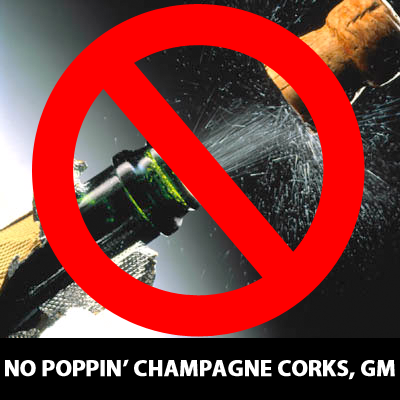
Toyota – Should They Be Popping The Champagne Corks At GM?

You may be a late night-er and have caught one of the talk show hosts doing a bit about Toyota’s latest nightmare. For decades, Toyota has had a market perception which GM could only dream of. People bought a Toyota because they were safe, reliable and had a high resale value. Maybe that was true but obviously, that reputation has taken a major blow to the nether region.

What does this all mean for GM? Well as far as GM’s current business strategy, hopefully nothing at all. You see, the old GM would have been jumping for joy at this latest set of unfortunate events. Some old GM folks may have felt that they could “loosen the belt” a notch or two, sit back and watch the customers come calling. In today’s market however, this attitude will never put GM back at the top.

Instead, GM must look at Toyota’s setback not as a victory, but rather as an event which brought the one opponent within sight. Companies such as Ford and Hyundai (watch out) will continue to rapidly improve their products and service to the point where they will surpass Toyota. Don’t think so? Take a walk into your local Hyundai dealership and check out the panel gaps – they are shockingly narrow. Now compare them against anything Toyota or Lexus has and you’ll see what I mean.

The battle for product and service improvement must be continuous and irrespective of what setbacks a competitor may have. In that regard, GM still has a lot of work ahead and hopefully, the folks at the New GM will run this race more determined than ever and they better - the Koreans are bringing up the rear and gaining ground fast.

Posted via web from Hylton Jorssen's posterous