Tuesday, June 22, 2010

GM Dealerships: Let’s Stop Calling Them Customers Okay???


One thing that really burned my ass under Henderson’s reign was that he continuously referred to GM’s dealership network as “customers”.

Why did that upset me? Because if dealers feel that they are a customer and should be treated as such, it makes it impossible to put the end-consumer first. On top of that, it’s very difficult to implement new approaches to sales and service. In other words, where else would business (GM) try and tell a customer (a dealer) how to run their own affairs?

So if GM dealerships are not GM’s customers, what are they? Like the thousands of other companies with which GM builds relationships in order to produce and market the company’s vehicles, dealerships should be treated as suppliers: they are suppliers of marketing, suppliers of vehicle service and suppliers of sales service. In simple terms, GM dealerships provide a service to GM and multiple services – along with the ability to buy a product – to the consumer. If anything, the dealerships should be kissing GM’s butt (like some suppliers do) since it’s GM that allows them to earn a living.

It’s no secret that even after the failure and rebuilding of GM, it’s still business as usual at some dealerships. For example, it’s still common for dealers to employ sales reps who know less about the product than the customer walking through the door.

This one issue alone is reason enough for customers to dread the dealership experience. Consumers now see how much gobble-dee-gook a poorly educated sales rep is dishing them when they already know everything the salesman knows and then some. Problem is, the sales reps don’t realize what is occurring in this scenario and end up burying themselves and any deal.

Over the last 20 years, the buying habits of the American consumer has changed dramatically. How? We are now able to sit down in the comfort of our own homes and do our own research on our own time. We can make up our own minds about a vehicle to the point where the only reason for going to a dealership is to test drive something. But even the lack of a test drive will not stop people from ordering vehicles these days – GM had almost 12,000 Camaro orders before the first car was even built yet. That number would have been even higher had many consumers been able to by-pass the dealer.

Less known (even to GM brass) are the more unethical practices occurring in the trade surrounding the sale of their vehicles. For example, did you know that even though you custom ordered a vehicle to your specifications and put a deposit down, the dealer is under no obligation to sell it to you? In fact once the car arrives at the dealership, he is free to ask even more for the vehicle, citing “market conditions” as the reason for spiking the price. Keep in mind that this is despite the fact that you have a written contract (fine print is a bitch).

Last year, I was contacted by someone who had ordered a 2010 camaro back in September 2008. He had ordered it exactly as he wanted it and spent the entire winter dreaming about the shiny new Camaro that would be in his driveway shortly after they begun production in April 2009. Once his car arrived at the dealership, the salesman called him and told him to “come on over to sign the papers, the car is here!” How excited he was – he grabbed his particulars and headed down to the dealership. Once there, he was brought into the office and was told that the car would now be $3,000 more due to “market conditions”. It was $3,000 that he had not budgeted for and could not come up with. In the end, the deal went south and the car was put on the lot with a price above MSRP.

What was the result of this scenario? The dealer either got itself a short term spike in profit because someone most likely ended up paying more than MSRP; or the dealer got itself a lost sale that our would-be owner does not know about. For GM though, both scenarios resulted in one less customer for the next 10 years. If that customer turned around and bought a Mustang, their next car will most likely be a Ford as well and the individual will do nothing but curse the GM name to anyone who would listen. That’s the unfortunate part, the dealer is the face of GM and rarely does the customer comprehend the separation of the two.

So how can GM face the challenge of ensuring that good dealerships are properly recognized? First, they need to change their internal and dealer culture so that all clearly understand who works for whom. This simple change will allow GM employees who work on the sales side to come up with better strategies and programs that focus on the consumer as well as send a message to the dealerships that there are expectations to be met. Secondly, these new strategies must reward dealerships who perform well and penalize those who perform poorly. The “Turn-and-Earn” program is a good start but I don’t think it goes far enough on the penalization front. The CSI program has value except it is highly inaccurate due to only measuring those who purchased a car and not those who tried to purchase a car but left in dismay (huge gap). GM still has about 1,500 dealerships more than it really needs, so stripping someone’s franchise away should certainly be a possible outcome of poor performance.

GM must also better educate the consumer so that they understand poor service is not the normal practice with GM dealers and that certain practices (legal or not) are not something GM condones. Consumers understand that they have a choice in picking the manufacturer for their hard earned money but GM should also educate the consumer about the choice they have within the GM dealer network. Do you know which GM dealerships have the most awards and the reason the merit behind these awards? Me neither and it’s GM’s job to let you know before you decide to walk into a dealership. There’s only one customer and that’s you.

Posted via web from Hylton Jorssen's posterous

Wednesday, June 9, 2010

“OnStar, What Is Your Emergency?” I’ll Tell You What My Emergency Is…

You may have seen the OnStar commercial where the viewer is looking through the window of a cop car as it goes after a stolen blue Chevy Tahoe. The law successfully pulls over the Chevy after OnStar remotely starts blinking its lights. Strangely enough, of all the services that OnStar offers, the stolen vehicle recovery feature is what OnStar appears to promote the most. The commercial makes its point, but is it really going to motivate you to cough up a minimum of $200 per year for the service? Think about it… I thought that paying for vehicle theft recovery was covered through our cities’ policing budgets (that we pay for through taxes). And combined with my vehicle’s insurance policy, I think I’ve paid enough already. 

What Is OnStar?

As many of you know, I am the proud new owner of a 2010 Camaro SS which came with a one year trial of the OnStar service. This has allowed me to really get the warm and fuzzies for it. What is On Star? It’s a billable monthly service that gives drivers ten security features:

  • Automatic crash response
  • Emergency services
  • Crisis assist
  • Stolen vehicle assistance
  • Remote door unlock
  • Roadside assistance
  • Remote horn and lights
  • OnStar vehicle diagnostics
  • Hands free calling, and
  • Turn-by-turn navigation

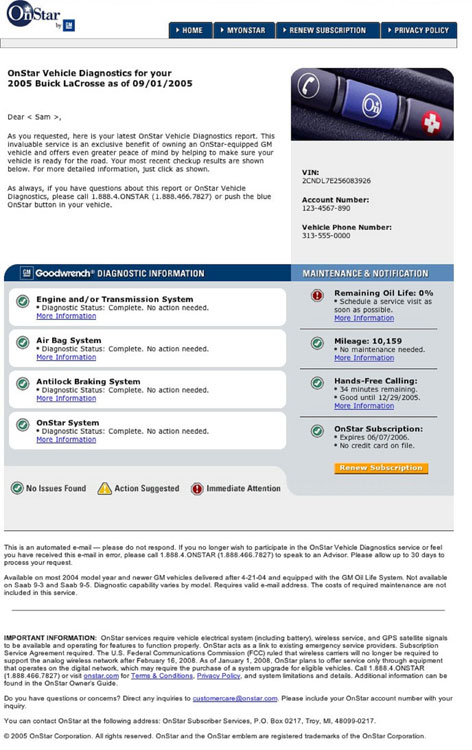
Of these ten services, there have only been two that I have used and appreciated: OnStar vehicle diagnostics and turn-by-turn navigation. I actually find turn-by-turn to be extremely good and – although some of my friends have found themselves misguided by the directions – it has never let me down. I also like the vehicle diagnostics report that is emailed to me once a month. The report is very clear and goes through the essential systems within my Camaro to ensure that all is copacetic. It’s a very nice feature that allows you to easily keep track of your car’s history. Other than those two services (and hands free calling), the rest of OnStar services are really for emergency use that maybe one in every 1000 subscribers will ever use.

The Question

And therein lies the question – is the service really of value to us? How often have you needed to contact emergency services while in your vehicle? For example, my Blackberry is connected through the superb Bluetooth connection in my 2010 Camaro and all I need to do is press a button on my radio to call 911. The cost to me? Not an extra penny (besides the cellular service I’m already paying for). To GM’s credit, they do realize that when people are in a severe accident, they may be so gravely injured or in such state of shock that they may be unable to call emergency services. For those OnStar subscribers who have been in that situation, they found the immediate voice of an OnStar agent irreplaceable and therefore swear by it. That experience is what made them true believers. If GM could have us all feel the same way as someone who experienced OnStar during a time of need, we’d all be OnStar subscribers.


Example of vehicle diagnostic report sent monthly to Onstar subscribers


So even though OnStar faces the challenge of marketing a service we clearly don’t need or want (based on the amount of new GM owners who choose to renew the service after the complementary one year), is there something else that OnStar can possibly provide to make us want to buy it? Let’s look at the following possibility.

What If?

We have a technology that facilitates communication between the outside world and the driver/passengers in the vehicle. OnStar’s service (over satellite and cellular) allows for rapid transmission of data and currently seems to be underutilized with respect to its overall transmission capacity. What can OnStar do that would make better use of the service’s infrastructure while benefiting the consumer at the same time?

What if OnStar offered internet access in your car? How about the ability to download and/or stream movies and mpegs (like our free General Motors podcasts) while sitting in your car? Suddenly, you no longer mind driving your spouse to the mall to do some shopping.

What if OnStar combined Bluetooth technology and allowed you to use your handheld device to connect to the Internet at a cheaper rate than what your phone company charges? For all you GM owners who have a navigation screen, how about the ability to use your nav screen to surf the net while killing time (waiting for your significant other at the mall)? We recently wrote about a dealer-installed service for some GM models that allows Wi-Fi connectivity in your car. Yet even this solution – although effective – may be priced out of reach for the average GM customer.

And for those of you envisioning idiot drivers attempting to surf the net and drive at the same time – there are ways for GM to prevent this from happening (such as to disable the navigation screen’s web-browsing ability if the vehicle isn’t in park). And here’s another thought – what if OnStar automatically sent you your email, Twitter or Facebook messages and displayed them on the radio information panel or HUD as soon as someone sent them to you? Better yet, what if it read them out loud to you?

Who Will Get There First?

As you most likely realize by now, GM hasn’t exploited the OnStar system to its full potential. But as sure as the sun sets in the west, one automotive manufacturer will not only bring in-car internet service to market first, they are also going to offer it with a very friendly user interface and at a very attractive price. What The General has going for it is that OnStar has a well-established infrastructure compared to those of other manufactures and can actually leapfrog competitors with a bit of forward-thinking. What’s more, the OnStar brand is well-known, even if people don’t know about every single feature the service offers.

Chris Preuss

Another feather in GM’s hat is Mark Reuss’ decision to have Chris Preuss take over the helm at OnStar. Chris was previously GM’s Vice President of Communications and he did a wonderful job introducing social media to the gargantuan organization. This accomplishment should not be taken lightly: recall the days where your phone call, letter, or email to GM would go unacknowledged. Indeed, GM has understood the value of social media and OnStar is just one more vehicle (pun intended) that gives GM the ability to profit from improved communication.

Posted via web from Hylton Jorssen's posterous